TikTok Shop Video Scripts That Convert: The 2026 Content Formula
Most TikTok Shop videos that underperform weren't shot badly — they were never really scripted at all. Someone hit record, talked about the product for 45 seconds, and hoped the algorithm would sort it out. In 2026, that's not a strategy the platform rewards: retention is the signal that decides distribution, and retention is decided in the first couple of seconds, long before your product even gets its close-up.
Here's the script structure, the timing data, and the shot-list basics that separate videos that get watched (and bought from) from videos that get scrolled past.
The first two seconds decide almost everything
Retention data from 2026 is blunt about this: the first 2 seconds of a video determine over 70% of whether a viewer keeps watching, and hooks placed in the first second get roughly 41% higher retention than ones that take longer to land. TikTok's own creative research backs this up — 63% of its highest-performing videos earn their audience within the first three seconds.
The completion-rate bar has also moved. A 50% completion rate was enough to have a shot at going viral back in 2024; in 2026, you're generally looking at 70%+ completion before TikTok's algorithm treats a video as worth pushing to new viewers. That's not a nice-to-have metric — it's the gate your script has to clear before the rest of your content strategy even matters.
Practically, that means the hook isn't the intro to your script. The hook is the most important line you'll write, and it deserves more editing time than the rest of the video combined.
The four-beat structure that actually sells
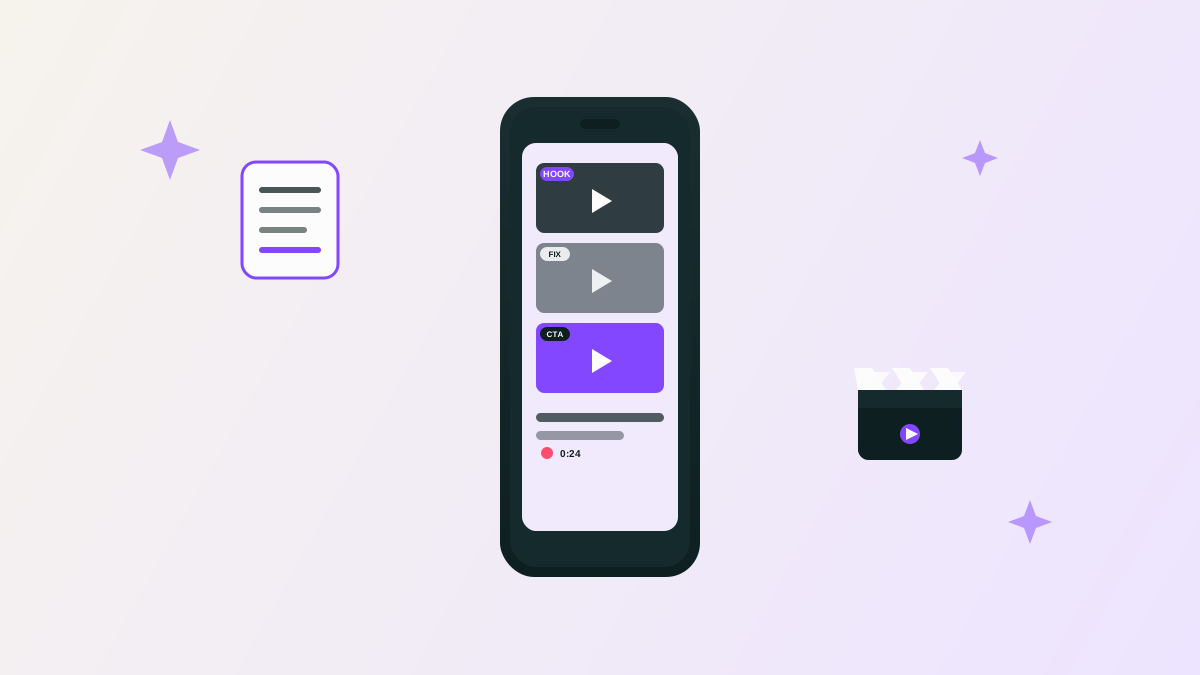
Strip away the production polish and almost every TikTok Shop video that converts follows the same skeleton, a variation on the classic Problem–Agitate–Solution formula:
- Hook (0–3 seconds) — stop the scroll with a surprising stat, a blunt statement of the problem, or a visual that doesn't look like a typical ad.
- Problem (a beat or two) — name the exact frustration your viewer feels, specifically enough that they recognize themselves in it.
- Solution, shown not told — introduce the product mid-use, solving that exact problem, with one concrete result or proof point rather than a list of features.
- CTA — one clear next step.
Data-backed hooks — a statistic, a specific number, a "here's what changed" framing — get roughly 35% higher engagement than hooks that lean purely on emotion, so if you're stuck on an opening line, start with a number from your own results (return rate, time saved, before/after) instead of a generic "you need this."
How long should the video actually be
Length is where a lot of otherwise-good scripts get bloated. The 2026 data points converge on a narrow window:
- 21–34 seconds is the sweet spot most often cited for feed content completion rate.
- Videos under 10 seconds see about 27% more completions — useful for a single sharp product moment, not a full pitch.
- For cold-audience ads specifically, 15–30 seconds (roughly 40–80 words of spoken script) is the target.
- A 90-second script tends to lose most viewers by the 20-second mark. If your draft runs long, cut 30% of the words — the tighter version almost always outperforms the original.
Write to a word count before you film, not after. If your script reads at 150 words, you're already writing a video nobody finishes.
Write the hook last — and write five of them
The body of a script rarely needs to change once it works. The opener does, constantly. Sellers who ship content consistently in 2026 usually keep a rotating set of 4–6 hook templates (a stat, a myth-bust, a "day in the life," a direct callout of the problem) and test them against the same body and product footage, rather than reshooting the whole video every time engagement dips.
When it comes to the close, resist the urge to hard-sell every single time. Soft CTAs — "follow for part two," "save this for restock day," "comment your biggest struggle with [problem]" — keep viewers engaged with your account instead of bouncing, and that ongoing engagement is what feeds your next video's distribution.
The shot list that supports the script
A script only converts if the footage backs it up. That means: your product actually shown in use (not held up and described), a stable shot, and decent lighting so the "solution" beat is easy to see — the same basics TikTok has been pushing across LIVE and video content alike. List-style scripts ("3 mistakes," "5 things I wish I knew") also tend to hold attention better than a straight pitch, because the numbered structure gives viewers a reason to stick around for the next point.
None of this needs a studio. It needs a script you actually wrote down, a hook you edited harder than the rest of the video, and a length you decided on before you hit record — not after you're staring at a 90-second cut wondering where the viewers went.
Where this fits into a real TikTok Shop strategy
Scripting is the cheapest lever in your entire content stack — it costs nothing but time, and it's the single biggest reason two videos with the same product and the same production budget get wildly different results. If you want help building a repeatable script framework and hook rotation for your specific catalog, that's exactly the kind of thing we work through with sellers on a strategy call.
Ready to put this into practice on your own TikTok Shop?
Book a free consultation call and we’ll help you turn these ideas into a working creative and growth plan.
Book a callMore from the blog
TikTok LIVE Selling in 2026: 6 Things That Actually Drive Conversions
What separates a TikTok Shop LIVE that converts from one that doesn't — real engagement and conversion data, the scheduling habits that work, and TikTok's new 2026 rule most sellers haven't caught up to yet.
July 22, 20264 min read

AI Video Ads for TikTok Shop: What Actually Works in 2026
A practical, no-hype guide to advertising products with AI-generated video on TikTok Shop — the tools, the real performance data, and the disclosure rules you can't skip.
July 20, 20266 min read